Cycle Breaks founder, Andy Patton, goes for a colourful off-season spin along the largely traffic-free Baltic Coast Path from Lübeck to Stralsund, to discover even more about Germany’s unspoilt and unsung treasured islands.
The Baltic Coast in Germany is ideal for cycling. It’s renowned for redbrick Hanseatic towns, beautiful amber, the stunning National Park islands of green and gorgeous West-Pomerania, and its first class cycle path – EuroVelo cycle route 10. Now that’s a whole traffic light of good reasons to set off and explore!
So what was Andy’s verdict? ‘The Baltic Coast and West-Pomerania are beautiful. Real gems. Brilliant for cycling holidays (on regular bike or e-bike). Do pack your binoculars, get set and go, go, go!’
Read Andy’s journal from his Baltic Coast bike adventure and find out why.
Baltic-bound
Day 1 – Starts (and stops) – London Stansted to Lübeck
Come on, who doesn’t love a good map? After years of planning cycle breaks, maps are more than just a tool of the trade – for me, they’re a bit of a passion. Even bleary-eyed after a very early start, a mega-map on a Hamburg airport S-Bahn platform had the power to draw me in. A friendly local read that as me being lost, offering (in English) assistance with a smile.
At the main station, whilst deliberating over which train to take, one of the options disappeared before my eyes. Before boarding what I thought to be the correct train to Lübeck, I checked with a railway worker and it became clear that it wasn’t – there was a problem and I heard S-Bahn and S2, but understood nothing else. I decided to join the crowd and headed to the S-Bahn. I jumped on a very crowded train heading north (I think!) but I had no idea how long to stay on the train for.
 After a few stops the crush did ease a little and I noticed a group checking phones and seemingly discussing route options in both German and English. It turned out that they were medical students heading back to university and they were very happy to add a confused Englishman to their ‘family’ of elderly Germans and a pair of Brazilian tourists. With their guidance, we knew when to change to another train before a 1km yomp across a small town to pick up the Lübeck mainline trains to continue the journey. What a nice, friendly introduction to Germany.
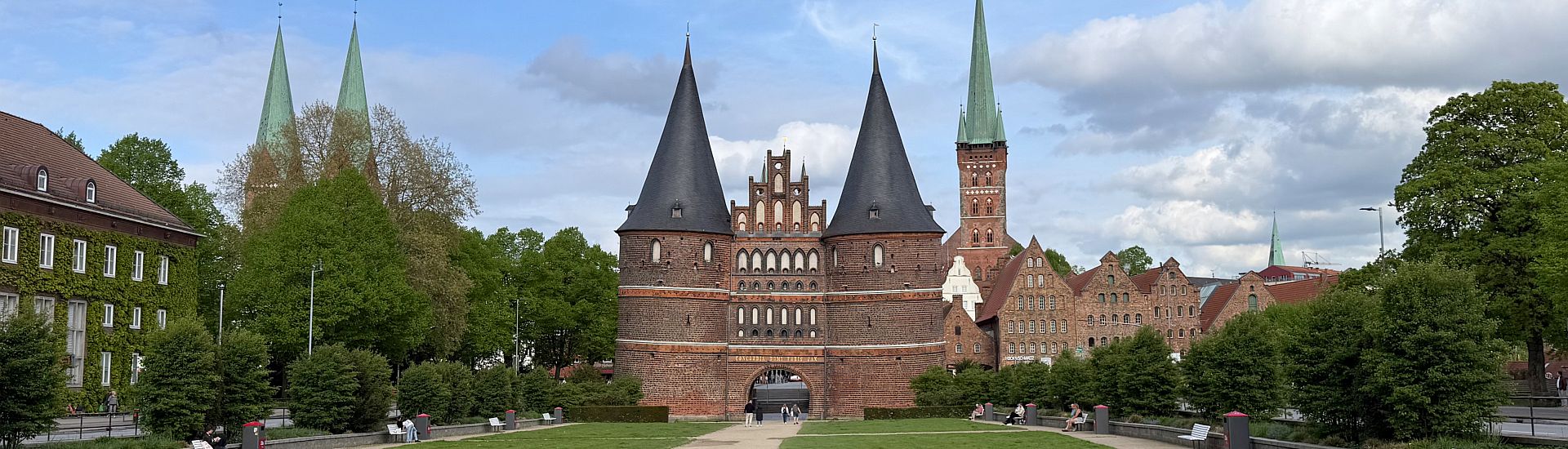
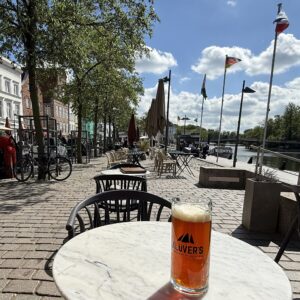
As I emerged from the station, I was struck by the Lübeck skyline of towering spires as I walked in the sunshine to my first hotel. My bike was waiting so I was keen to jump onto two wheels and set off to explore the Altstadt. Lots of bike friendly cycle paths (and not so friendly cobbled streets), before eventually settling down for my first refreshment in the sunshine on the riverbank just beyond the Holstentor, the medieval gatehouse that is now the symbol of the city.
Out & About on the Ostsee Radweg
Day 2 – Breezes & Beaches – Lübeck to Wismar
Waking up the following morning to rain was a little disappointing, but I was eager to get on the road and head out to the coast. I had spent time studying the detailed routebook and the strip map for the Ostsee Radweg , which together provided good detail as well as context, but I was very happy to navigate using gpx tracks on my elderly wahoo. The ride north to the ferry at Travemünde was fairly uninspiring, although I was interested to experience the bike-shuttle bus that ran every 10 minutes or so through the road tunnel under the now very large river. (A popular option to shorten what would normally be the longest cycling day on this trip is to take the S-Bahn to Travemünde).
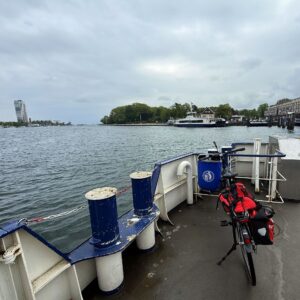 I struggled to pay for my ferry tickets (one for me and one for the bike) by card before again caving in and paying with cash. By this stage the ferry was already loading so I quickly rode over and merged with the cars rolling onto the ferry only to be shouted at by the quite angry lady who was supervising operations. I suspect (the language barrier has its uses) that she considered mixing in with the cars may be too much for the average pampered German cyclist, used to segregated cycle paths and deferential drivers, but it was no problem for this ignorant English cyclist who had duelled with the traffic around Elephant & Castle and Hyde Park Corner in the 80s! I tried not to smirk too much as she kept me in detention at the far side until every vehicle, cyclist and foot passenger had disembarked. Suitably chastened, I set off in the now hazy sunshine to start riding the Baltic Coast Path proper.
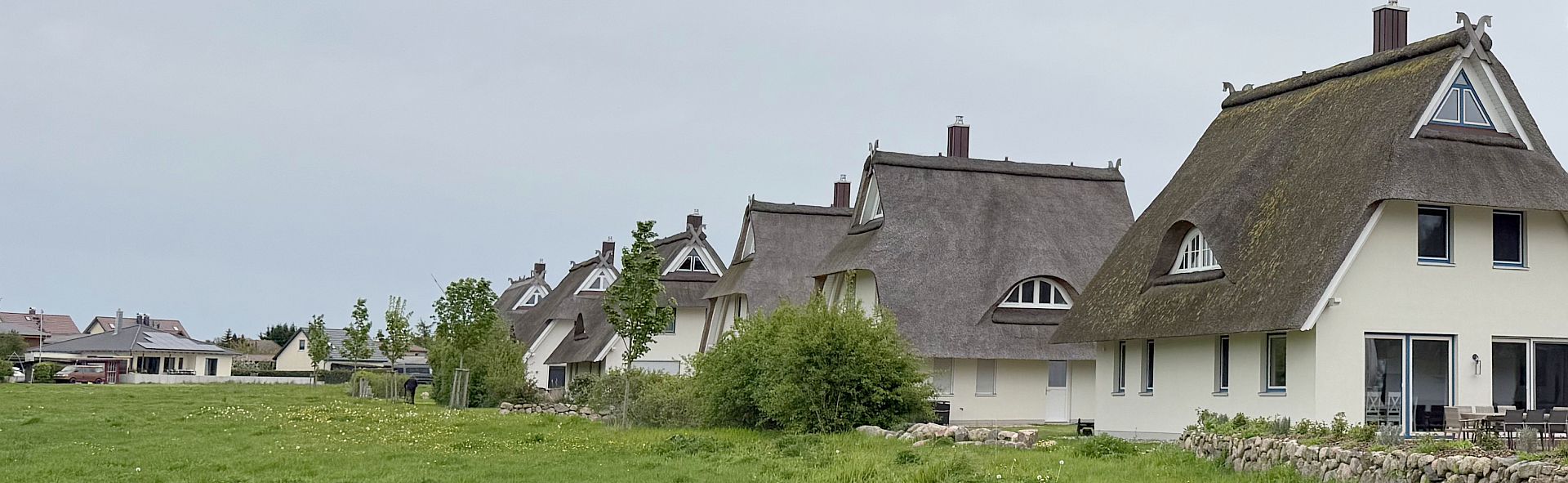
The cycle path through open farmland was helpfully easy-going and well signposted. Initially I felt slightly miffed that trees often stood between me and the beaches but then I started to appreciate the shelter they could provide from a sea breeze. With the countryside of Mecklenburg gently unfurling beneath my bike wheels, the day of rural and coast-side cycling was a pleasant one. As well as spotting the first of many thatched cottages, other memories include the ‘pretty’ (I jest not) portaloos dotted along the route and the wide expanse of Wismar Bay. Landing in Hansa town No. 2, Wismar, it was a real bonus to find my hotel located by the historic redbrick gateway and warehouses, across the road from the yacht basin. Everything was on tap (not just the beer!) with no bike-on-cobbles outings necessary!
Going that extra Baltic Coast mile
Day 3 – Causeways & Crêpes – Wismar to Rostock
At Cycle Breaks, we have a policy of visiting all of our destinations in person and cycling as much of the routes as diaries will allow. This will often mean combining days which, with the passing of years, become a little more challenging. In that vein, Wismar to Kühlungsborn Wednesday became a miles-more-to-cover challenge day, continuing on to Warnemünde and Rostock.
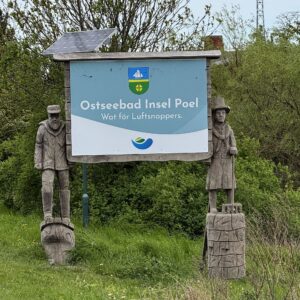 Few folk can resist a causeway. The one across to the Island of Poel takes the form of a bridge but this was the briefest of encounters as back on the mainland, there were villages to explore and kilometres to cover. The signposting and cycling on shared-use paths was something I quickly got used to, noting where pavements became pedestrian only in village centres or near schools. The thatched houses also started to become part of the street furniture.
I took a shine to the small resort of Rerik, but Germany’s highest lighthouse at Bastorf just outside Kühlungsborn soon grabbed my attention. Kühlungsborn is a smart spa town, dotted with Art Deco delights and what we would call Edwardian-era villas. Time to take in some refreshment on the Ostseeallee beach promenade – a hot chocolate ably supported by a banana & Nutella crêpe, a spot of shelter and blanket over the knees (yep, what a whimp!) was what this cyclist required to get back on track. Fortification indeed, and enough to brave the ‘ghost forest’ of skeleton beech trees, ravaged by the salt-spray at Niehagen later.
As I continued to pedal against the Baltic Coast breeze, it gently dawned on me why a good number of fellow cyclists on the path had availed themselves of e-bikes. Finally, before I knew it (well, my legs were beginning to know it perhaps), I was clocking up Hansa town No.3 and more impressive redbrick architecture in the form of Warnemünde. At the quay, I had a coffee and a dilemma – S-Bahn to Rostock, or 16 more kilometres? Resolving that I’d already had my whimpish moment in the Kühlungsborn café, I made for the suburban cycle paths and eventually was rolling alongside the river as I approached Rostock’s Altstadt.
Cycling Germany’s Lagoon Landscapes
Day 4 – A string of treasure islands – Rostock to Zingst
This was the day I’d really been looking forward to, my chance to explore three former islands joined to the mainland after a storm surge in 1878 – the Darß-Fischland-Zingst peninsula. Once again, I’d be reluctantly speeding through, but the essence of these treasured islands is not just the stunning nuggets of amber thrown up the shoreline, but the raw, natural coastal landscapes, the magical light and wildlife, and I’d be able to experience them all from the saddle.
Setting out I passed the mighty Stein Tor (gatehouse) as I skirted Rostock Altstadt, appreciating the excellent cycle path provision in and out of the city. On route to the coast, there were plenty of easy forest trails that provided shelter and sun-bloc. (Let’s put it out there – I was in short sleeves and shorts; the rest of the German May-time cycling population went for less hardy options!) At Dierhagen , my encounter with the sweeping and wildly beautiful ‘island’ landscapes began with the island of Fischland, and my thatched cottage tally went into overdrive.
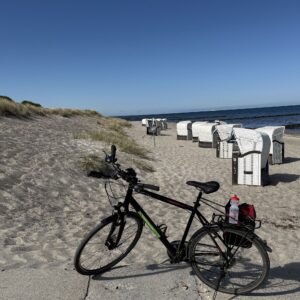 Along the silver-gold sliver of dune-landscape between lagoon and ‘Ostsee’, the Fischlander Weg propelled me past Wustrow beaches where the on-sand trend for white-painted, wind-breaking wicker-basket beach snugs or ‘Strandkorber’ really began to come into its element. They presumably also helped to provide a modicum of welcome shade in the sunnier months. Past stunning sea cliffs, rolling hills and reedbeds, I reached Ahrenshoop. And no prizes for guessing why this remote fishing village became so popular with artists. Reed-thatched houses, elemental land- and seascapes, a light which delivers a whole new world of definition – coasting along on a bike, the sheer beauty was tangible.
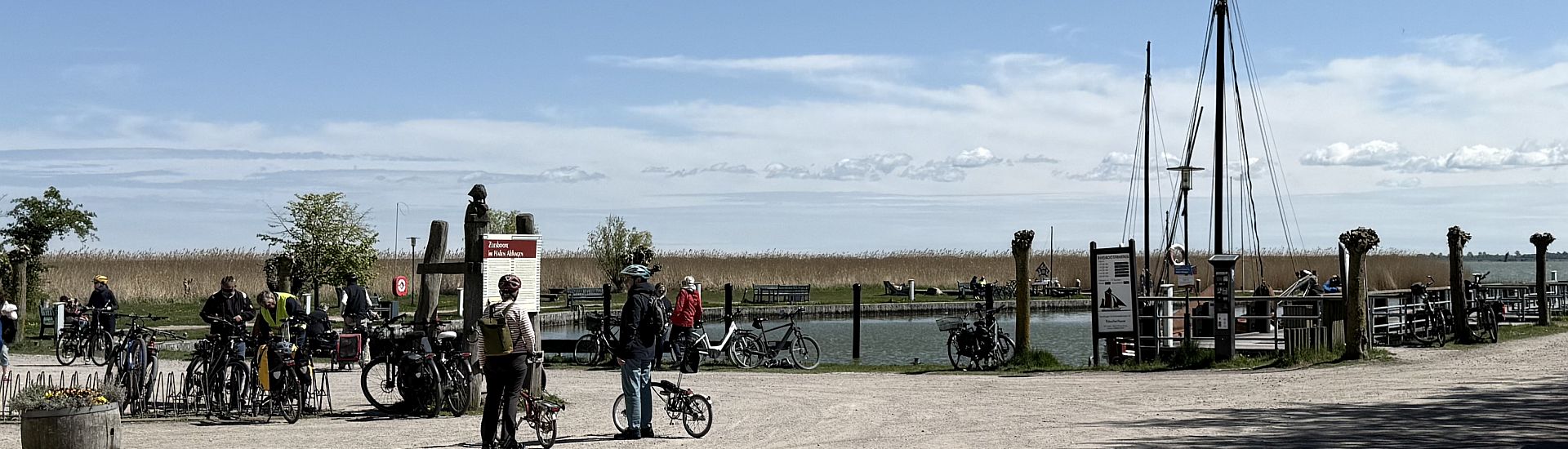
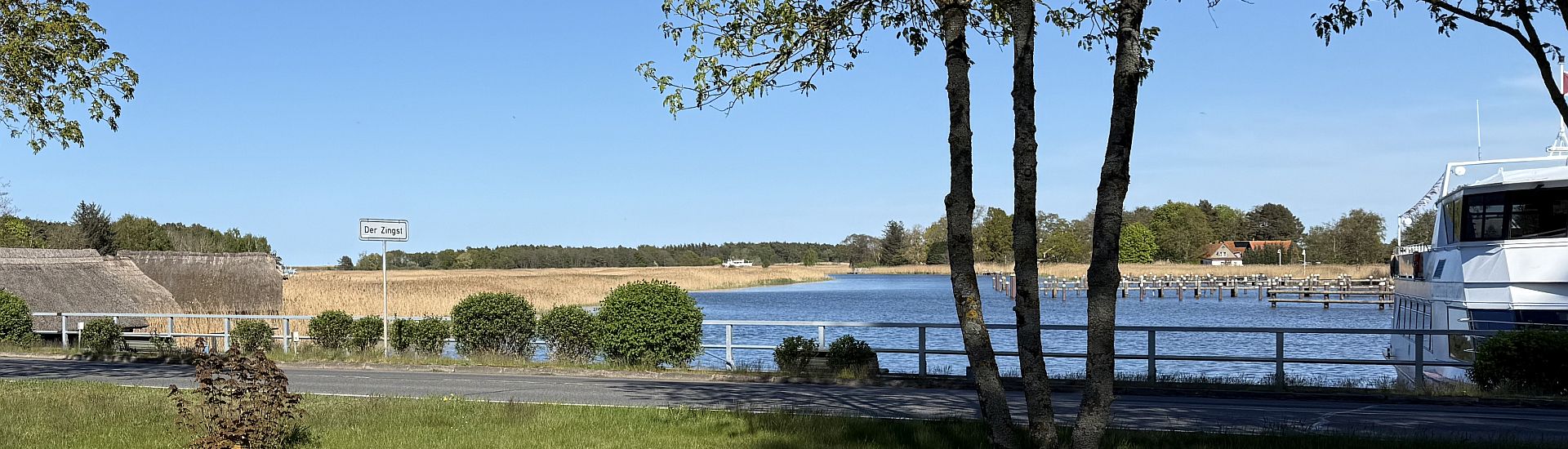
As the peninsula curved east, one-time island Darß heralded the Vorpommersche Boddenlandschaft (Western Pomerania Lagoon Landscape) National Park and the diverse natural landscapes just kept coming – forest, sandy stretches, wetland, dunes and reedbeds. Stopping for a short break on a long straight dyke across the lagoon I got close to a crane, camouflaged by the reeds. The night was spent in the small resort of Zingst, on its eponymous island.
Peninsulas & Pinnacles
Day 5 – Magical Moments & Meet-ups – Zingst to Stralsund
Located on the lagoon side, the harbour in the town of Zingst was the starting point for my final day’s ride. It was time to head towards the bridge and back to the mainland to view the island of Zingst from the other side of the lagoon. Hansa town No. 4, Stralsund, was destination of the day.
This far east in Germany, identities seem to be jumbled in the mind by history. Time spent with the map that morning had tried to make the connection between the small, lagoon-side town of Barth with its ‘Gateway to the Baltic Sea’ title – and to work out how it could once have been part of Sweden.
‘Glöwitzer Berg’ had leapt out of the map and caused some excitement, although the actual gentle rise experienced was perhaps evidence of a German sense of humour (akin to the ‘Suffolk Alps’ in the never-more-than-gently-rolling lands of home).
Farmland, lagoon-land, twittering reed beds, hedgerows and green pastures – regardless of any inclines or lack of, the cycle path kept on giving. At one point I found myself riding in the close company of a marsh harrier. We were tracking into the wind together, for what seemed like minutes – another of those moments, where the wheels carry on whirring, but time stops still. A real memory to treasure.
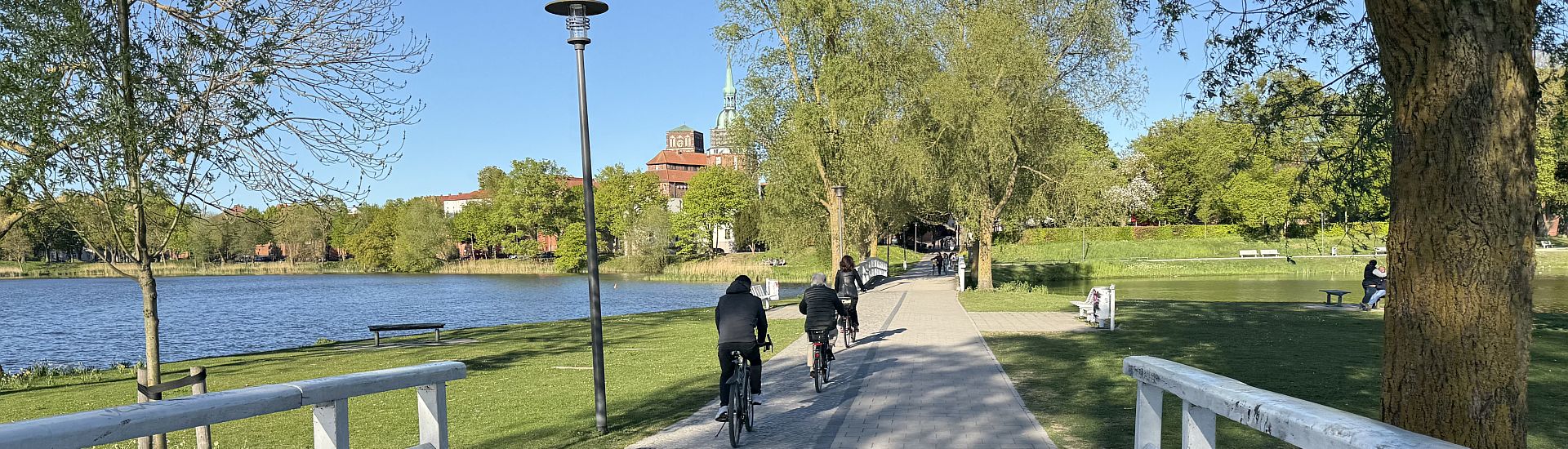
A final short inland section saw the path meet the coast again and reveal the historic towers, pinnacles and impressive bridge of Stralsund lying ahead. The last few kilometres morphed into some pedaling through parkland, before I steered my way to Stralsund harbour and eventually settled for a celebratory end-of-tour beer in the busy Altstadt market place.
Andy’s German Baltic Coast Bike Tour
Key Stats
Distance Covered: +/- 235 miles (378 kms)
UNESCO World Heritage Hansa Harbour Towns Visited : 4
Islands Explored: 4 (or 2 peninsulas if you want to be pedantic)
Punctures Repaired: None
Friendly Faces: Countless
Beers Savoured: Well, that would be telling
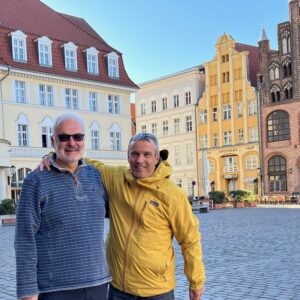
Meet the Cycle Breaks Baltic Coast Team
One of the joys of our overseas route check in trips, is to get together and catch up with our extended team – our partnering colleagues who help make our overseas tours happen and fly the Cycle Breaks flag on the ground.
It was great to see Thomas (pictured in the yellow jacket) and Beate on my final evening in Germany. We enjoyed a walking tour of Stralsund and a traditional supper, polished off with a schnaps at a lovely old ‘pub’ apparently famed for hosting an informal mini-summit between Angela Merkel and François Hollande!
Top Tips & Takeaways
- Marzipan – In Lübeck it’s got to be Niederegger in the red wrapper; in Stralsund, Sumara marzipan is actually made by our partnering colleagues, Thomas and Beate! Try their little seashorses (Seepferdchen). Generally Baltic Coast marzipan comes dark chocolate covered and made of all almond paste (not sugar!). A treat, a gift and a must-try without a doubt.
- Cash – Carry some. At times it still seemed to be king and certainly made buying ferry tickets easier.
- E-bikes – To e-bike or not to e-bike, that is the question… They are clearly very popular in Germany and although the terrain was very gentle and the paths easy-going, an e-bike can help counter any headwinds.
Discover our 8 day / 7 night Baltic Coast Cycle Tour in Germany
Baltic Coast & its Hanseatic Heritage – Baltic Sea Cycle Path
Cycling Holidays in Germany – find out more :
Cycle Breaks Touring Holidays & Short Breaks in Germany
Bike & Boat Holidays in Germany, Austria & Hungary